1999 – Great Trango Tower, Pakistan
Details
Team: Mark Synnott, Alex Lowe, Jared Ogden
When: June-August 1999
Where: Trango Glacier, Karakoram, Pakistan
Sponsors: The North Face, Quokka Sports
Explore Mark's other expeditions:
July 26, 1999, 9 p.m. First hanging bivy, 18,450 feet, northwest face of Great Trango Tower. The western skyline resembles the jaw of a gnarled old troll: jagged, broken teeth, sharp fangs and stubby molars in a 180-degree semicircle. The moon rising behind our tower creates a blue halo around the fringes of the wall below, and its light reflects from the myriad ice ponds on Trango Glacier 4000 feet below. The bulk of the wall is dark and lifeless, save for the glow emanating from our tiny suspended shelter.
The luminescence does not issue from a hanging stove or headlamp, however, but the electric-green screen of the computer in Alex’s lap. Cords snake out of the machine in every direction, connecting with batteries, modems, and other gadgets. A three-foot antenna sticks through the stove vent, aiming directly at the communications tent in basecamp. We receive a message on the screen, one letter at a time:
“W-h-y a-r-e-n-‘-t t-h-e-r-e a-n-y P-o-l-i-s-h b-a-l-l-e-r-i-n-a-s?”
It’s our latest dirty joke from basecamp, and the signal that they’re ready to start receiving our daily data transmission. Today we did 600 feet of jugging and hauling on free-hanging static lines, then two hard aid leads up severely overhanging rock. After rappelling 1000 feet, I’d arrived at the portaledge too tired to even take off my boots. Jared and Alex had already busted out the computers and were hard at work. In addition to making dinner and trying to re-hydrate, we need to write emails and download digital images that document our day’s activities. It will be midnight or later by the time we pack everything up. At 5 a.m., Alex’s alarm will rudely wake me. Alex knows better than to leave Jared or me in charge of the morning wake-up call.
Two years prior, on our way to attempt the nearby 19,700-foot Shipton Spire, Jared Ogden and I got our first view of Great Trango’s northwest face. At nearly 6000 feet, it was the biggest wall either of us had ever seen.
“If only we had known about this thing,” I moaned to Jared, whose eyes were glued to the tower.
“I hear you, bro,” said Jared, finally breaking out of his trance. “I don’t see how Shipton could possibly be better than this.”
We spent the next two months staring at that northwest face from various perches on Shipton Spire, and by the time we finished our new route, were set on returning. We intended to come in summer 1998, but postponed after we both got invited to participate in a big-wall documentary on Baffin Island. We climbed a killer new route that season with Greg Child and Alex Lowe, and afterwards, while we all waited for our ride out, the conversation got around to what was next. I ran back to my tent and emerged with a photo of the northwest face. Greg had seen it himself from climbing new routes on Nameless and Shipton, but he seemed pretty burned out on big-wall slavery. Alex, on the other hand, practically salivated. “I’ve always wanted to climb something around Trango,” he told Jared and me. “Let me know if you need a third because I’m into this thing.” Within a month Alex, 40, was officially signed up. This would be his third trip to the Karakoram, having previously attempted K2’s North Ridge and Gasherbrum IV. It would also be Jared’s third. Aside from Shipton, Jared, 27, had done a new route on Nameless Tower in 1995. His dream was to climb new routes on all the main towers lining the Trango Glacier.
We all agreed on the need for a major sponsor. The Shipton expedition had been funded out of pocket and had cost a total of $10,000. Since Shipton was under 6000 meters, we’d done it without a permit or liaison officer. Great Trango Tower (6284 meters) was going to cost significantly more. In the two years since Jared and I had climbed Shipton, I’d gotten married and had a kid, so sucking the bank account dry and selling my car was no longer an accepted fund-raising strategy.
Mark on the Great Trango
A few weeks later, I found myself in a meeting at the San Francisco headquarters of an internet company called Quokka. My college climbing partner, John, had just scored his dream job, producing websites for Quokka’s adventure network. He was organizing his own expedition to the Chinese side of the Karakoram, and actively seeking other trips to cover. Making my pitch to John and his boss, Brian, I tried for all the catchiest sound bites I could think of: “It’s over a mile straight up; the summit is over 20,000 feet; it’s never even been attempted; we could be up there for more than a month; it could be the biggest cliff in the world.”
“Biggest in the world, huh,” said Brian. “Well, I gotta say, this sounds like exactly the kind of trip we’ve been looking for.” Coincidentally, another iron in the fire also came through around the same time. The North Face accepted our proposal to make a film of the expedition. Suddenly, we had more media coverage than we knew what to do with.
We arrived in basecamp June 22 with close to 10,000 pounds in porterage One hundred and fifty-five Baltis — eight times the number we’d had on Shipton — had carried this endless caravan of pelican cases, barrels, and haulbags. In addition to the three climbers, our team included two climber-cinematographers, Mike Graber and his assistant, Jimmy Surette, as well as Quokka’s field producer, Greg Thomas, and satellite technician, Darren Brito. Our liaison officer, Captain Umair Ahmed, rounded out the crew.
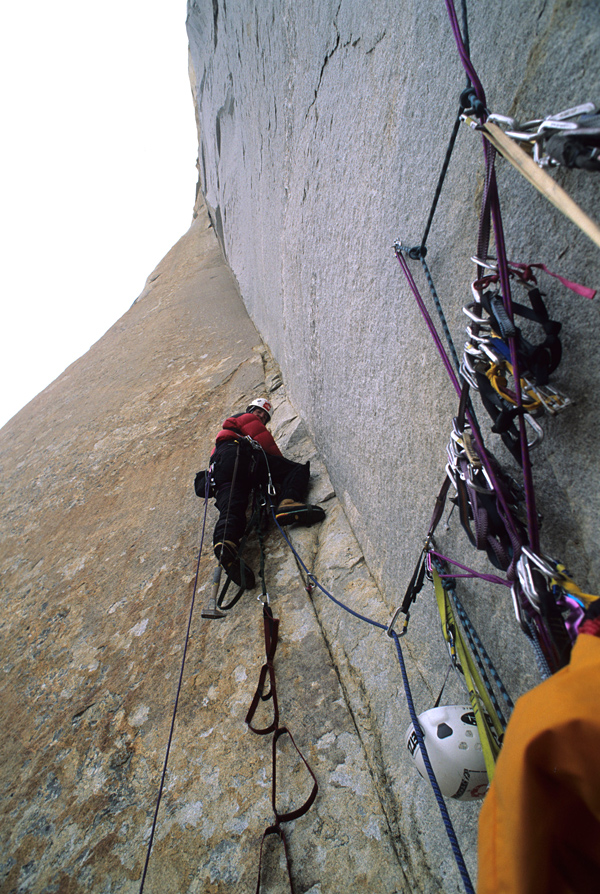
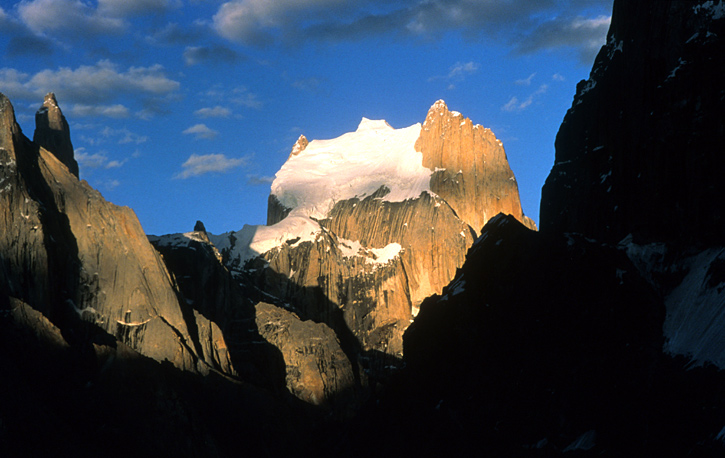
Now that we were finally sitting face to face with the objective, it was obvious why no one had ever attempted it. The entire bottom half of the wall, roughly the same size as El Cap, was a crackless slab, loose and dangerous-looking. The pay dirt lay above. Equal in size to the slab, the awe-inspiring upper headwall was vertical and overhanging, with several gigantic roofs. This was what we had come to climb.
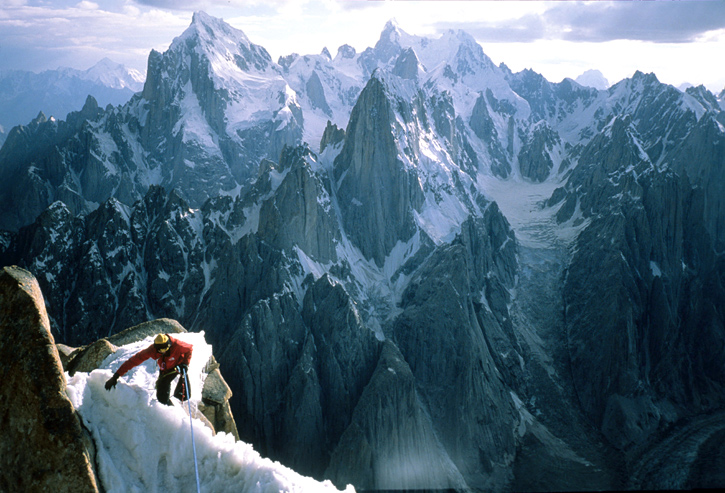
We started fixing ropes almost immediately and just as fast realized that hauling was out of the question. The slab was broken up and low-angled. We’d have to jug with our huge loads on our backs. A thousand feet up, we found a sheltered ledge big enough to live on for a while. Our first night on the ledge, we sipped hot chocolate and scotch as a purple and orange sunset lit up the surrounding peaks of the Trango Glacier. For the first time we could see the upper reaches of Shipton Spire, framed by the Cat’s Ears on its left and the pencil-thin Mystery Phallus to its right. Directly across from us, Uli Biaho, with its Cerro Torre-like mushroom, glowed in violet alpenglow.
The slab was turning out to be predominantly a free climb, with most pitches 5.9 to 5.10. We had expected loose choss, but cascading waterfalls had scoured and polished the slab. Our biggest problem was something typical of all Baltoro granite: most of the cracks were flared, often with nothing more than blade cracks in the back.
We were now getting into the rhythm of our daily website diaries, with a quirk or two, of course. A few early entries mentioning each other practically made us jump to our feet in our ledges, yelling, “Hey, you sonofa!” All of us found it unnerving to have our thoughts and every move recorded for the world to see. We decided on a rule prohibiting ourselves from surfing the site.
After 20 long pitches, we finally reached the base of the headwall. We’d fixed close to 3400 feet of rope, twice as much as I’d ever used on a wall before. Now we had to jug 10 haulbags’ worth of stuff up to the talus ledge that would serve as the staging ground for our next round of fixing. Mike and Jimmy volunteered to help us with the jug day from hell — an offer that almost brought tears of gratitude to our eyes. Starting at 4 a.m., the five of us started schlepping like never before. Alex, who lapped us all, made a total of four trips, while Jared and I each managed three before biting the dust. During this day I decided with absolute conviction that I would never put myself through another sufferfest like this one.
While we were fixing, a Russian expedition had arrived, and as we descended to basecamp for one final rest we were anxious to meet them. I had met one of their team members at a trade show, but he’d told me that his team had their sights set on a route near The Grand Voyage on the east face. Maybe I’d sprayed a little too hard about the northwest face, because here they were. We had a party with them our first night down, inviting their crew back to our two-meter dome for some cognac (theirs) and whiskey (ours). We told them about the conditions and what we’d found so far on our route. We asked them where their line would go, but they wouldn’t say. They did tell us that their plan was to climb new routes on the 10 biggest walls in the world. They had already pulled off routes in their home Ak-Su Mountains, on Bhagirathi, Changabang, and The Troll Wall. Our ropes were already fixed to the base of the headwall, so we figured we’d probably never even see them. We were wrong.
A few days later we were back at our high point. The headwall was blank at first, though two ski-track crack systems began at 400 feet. We aimed for the right-hand line, climbing three pitches of discouragingly featureless rock to get there. It was worth it, though, because the next section looked like the upper half of El Cap’s Dawn Wall. Splitter left-facing corners cut a line through three roofs of increasing size, culminating in a 25-footer 1500 feet above. The weather, which had shown us cloudless skies and temps in the 80s, turned south on July 18. Initially, we had been naive enough to think that because the upper headwall was so steep, we’d be able to keep fixing pitches even in bad weather. This had always been possible on my climbs in Baffin Island, and Jared and I had climbed straight through an eight-day
storm high on Shipton.
The day the storm came in, we were all at a new high point. Alex was nailing an A4 corner while Jared and I tried to organize the belay. I had a perfect view of the black wall of clouds that suddenly materialized at the head of the Baltoro. Within minutes, the wall was completely enshrouded. Craning my neck, I could just make out Alex’s shape in the swirling blizzard of huge fluffy flakes. At this point everything was still dry and the whole scene was very peaceful.
Ten minutes later, the fluffy flakes had transformed into a wind-driven mass of wet, dense slush. I wasn’t wearing any bibs, so within minutes my legs were soaked and freezing. I couldn’t believe Alex was somewhere up in this mess actually leading. Jared had the belay, so I started down the fixed lines as waterfalls began pouring down from above. The rope was completely encased in ice, which my ATC shaved off and dumped into my lap in a big gloppy pile. Our route followed a big traverse, so you had to rap into the V at the bottom of each line and then jug up to the next anchor. My jugs wouldn’t bite, so I had to scrape the ice off the line with my knife, inch by inch, being careful not to cut through the sheath.
Not one of us had brought a change of clothes. Everything was soaked, even my leather boots, which were so drenched I just left them sitting outside. We crawled into our bags wet, cold, and miserable — with another treat ahead. Tonight we had three interviews with radio stations back home. Our Yaesu radio actually had a phone patch through our satellite phone in basecamp, enabling us to send and receive calls right from the wall. Our first call was a morning talk show with two comedians who play off each other and try to make their guests sound like idiots. “So who exactly works at the 7-11s in Pakistan, anyway?” asked the guy from a station in San Diego. “You’ve been watching too much Simpsons, dude.” “How do you guys go to the bathroom up there?” “How graphic do you want us to get?”
great_trango_belay_240.jpg
The storm settled over our grovelly little bivy like a sickness and over the next several days we got practically nothing accomplished. No one wanted to come right out and suggest we bail, but you could tell it was on all our minds. Besides the weather, which was giving us a serious schooling, the route was turning out to be thinner than we could have ever imagined. Our cam supply was fine, because we had hardly placed any. It was the pins and rivets that were starting to look bad. Of our original 35 blades, only 10 remained, the rest having been fixed, dropped, or destroyed. The supply of 100 rivets was also getting down to the scraps. Two of our hammers had cracked handles, and one of the batteries for the power drill was dead. On the radio to basecamp, I asked Greg, “So, how big a deal would it be if we bailed?” He said the company would support whatever we decided to do, but he definitely wasn’t rolling out the welcome mat. We didn’t need him to tell us that our failure would be a huge disappointment to everyone at Quokka and to the hundreds of thousands of people following the Quokka website. Misery was just not a good enough excuse to bail. We still had time, food, and fuel, and no one was sick. Reluctantly, we decided to hang in there.
Sometime during the middle of this storm, as we lay in our soggy bags, we heard Russian voices nearby. An hour later, two comrades pulled onto our bivy ledge. We brought them some hot tea and had a quick conversation about their rapid progress. We’d gotten a two-week head start, but by climbing alpine-style they’d done the entire slab in about a week. We still had a good lead with almost 1000 feet of rope fixed above, but realized these guys might actually have a shot at scooping us. I personally liked every one of the Russians, but you could tell that they wouldn’t mind one-upping the American expedition. Looking at their homemade, scrappy old gear, I couldn’t help but admire these guys. Alexander, the leader, was wearing a set of carpenter’s tool bags, the pockets filled with titanium pitons. Nothing was clipped in. I asked him, “What if you fall? Wouldn’t you lose everything?” He looked at me and said, deadpan: “Don’t fall.”
Part of the reason for our slow progress was our extra work. In addition to producing the material for the web site, we were working closely with Mike and Jimmy to get film footage. We needed the string of fixed lines so that the two of them could move up and down the wall freely. We also dedicated two days for filming re-leads on some of the most photogenic pitches. Our stay on that soggy ledge tallied up to 11 days by the time we finally entered a sucker hole in the clouds big enough to convince us the storm was over. We headed up, hauling the last bits of our gear along, and set up the ledge below a clean, architecturally perfect corner system. Experience from other big walls had deluded us into thinking that a feature as large as this corner would contain some form of cam crack. Wrong. Every 50 feet it opened up enough for the occasional TCU or Stopper, but for the most part we were staring up at an endless string of beaks, blades, and heads.
Three pitches later came the most dramatic pitch of the entire route, the 25-foot roof that capped the steepest, wildest section of the headwall. The pitch, like every other one on the headwall, turned out to be extremely thin, but somehow Jared kept scrapping in pins and the occasional head. When he reached the roof I thought he’d be drilling for sure, but instead he started nailing his way out a knifeblade crack that ran straight to the lip. To clean the pitch, I had to aid across Jared’s pins, my stomach in my throat due to the unreal exposure and my fear over what a sharp edge must be under all that tape Jared used to pad the lip. After turning the lip, I couldn’t help but let out a cry of triumph for him — it was one of the proudest leads I’d ever seen, anywhere.
It is in our hanging bivy, July 28, when my dream that Alex will one day ignore the alarm comes true. The trouble is, I can’t enjoy it because I’m too curious about what has broken his morning ritual. I poke my head out my bag, and see Alex curled up on his side, holding his stomach. “Bad gut,” he mumbles, then vomits out the door. We’d all been worried about oral-fecal contamination. One haulbag had been left at the last anchor below the bivy, and over the course of a week it had been splattered with “mud falcons” that had failed to take flight. Yesterday we’d been forced to haul this bag into camp because it contained a third of our water supply.
Jared and I leave Alex to sweat it out in the ledge for the day. We jug our lines and fix two more pitches, and don’t return to the ledge until 7 p.m. Most of the 1200 feet of rope above camp is free hanging. Above our lines it looks like another 700 feet to the summit ridge, but we’ve finally found our way into a splitter crack system. Our next move would be to go alpine-style with bivy gear from the top of the fixed lines. We decide to see how Alex feels in the morning before making a decision about the summit. I am pessimistic about his chances for a full recovery by morning. But after everything we’ve been through to get to this point, no way will we go for the summit without him.
Meanwhile, after hooking up the modem and the antenna, I download 30 photos. Upstairs, Jared reads through the latest batch of emails from surfers sending well wishes and questions. Since NPR ran a segment about the climb a few days before, the site has been bombarded with emails, and Jared now reads some aloud: “Is there less gravity at altitude?” asks Chris from Berkeley. “If you climb high enough, will you float into space?”
I never hear the alarm. The first thing I comprehend is Alex’s voice, sounding perfectly normal: “So, should we go for it?” From my lower bunk, I stare out the door at a thick band of low-lying clouds moving in from the south. An hour later we’re jugging up the lines with bivy gear, some food, and the stove in our packs. Alex takes the first block, and quickly demonstrates that even in his weakened condition, he leads fastest. Jared and I call him our “Secret Weapon.” We’ve left the bolt kit behind and only carry a light rack of cams, pins, and Stoppers. I expect the summit ridge to be somewhat broad, but it turns out to be a knife-edge. The view off the backside takes my breath away: Masherbrum, the Gasherbrums, Broad Peak; only K2 is hidden in the clouds. The Baltoro, leading up to these peaks, is riddled with huge crevasses and giant ice lakes, each one a unique color: turquoise, forest green, pale green, brown, gray, even red.
By 3 p.m. we still have a long section of knife-edge to get to the unclimbed west summit. I take over the lead, surmount a small aid wall and then scramble across snowy, easy fifth-class terrain. Balancing along the crest of the knife-edge, I look directly across at the summit of Nameless Tower. I try not to get too anxious about our summit and just enjoy the climbing, because this is probably the coolest day I’ve ever spent in the mountains.
Just below the top, the west summit juts like a slender pinnacle 150 feet above the ridge. Alex takes off, weaving his way through a section of gendarmes. Stemming between two towers, he reaches across and begins palming his way up an arete. Suddenly, he pitches 50 feet off the back side of the ridge, his only protection the rope running over the spine. Jared and I yell his name into silence. A few minutes later he pops back up, says “I’m fine,” and starts firing up the pitch again as if nothing had happened. A half-hour later we’re all on top.
The top turns out not to be the true summit. A blank slab running in water goes up for another 15 or 20 feet. It’s dark now and the last bit looks runout and sketchy — even Alex doesn’t want to lead it. We have plenty of work ahead just getting back across the ridge to our bivy gear. After an open bivy on the ridge at 20,000 feet, we start rapping back down the headwall to our hanging camp. It storms heavily all morning, but by 1 p.m. appears to be clearing. The barometer shows a slight spike, so we dismantle the bivy and continue toward the base of the headwall. This turns out to be a huge mistake. By the time we’re two raps below our camp, with everything packed into eight huge pigs, the storm returns full force, unleashing the heaviest downpour of the expedition. As the shit begins to hit the fan, I can just barely make out the Russian’s pink portaledge through the mist. They’re making good progress, but still have approximately 2000 feet of hard climbing ahead. Someone yells: “Did you make the summit?” “Yes,” Jared shouts back.
Great Trango Tower – photo by Jim Surette
A long pause, then: “Congratulations!” We can just imagine how depressing the news must be. Unfortunately, we’ll have to leave basecamp before they top out.Twenty minutes later, as I dangle on the knot at the end of our ropes, the waterfall pouring on my head makes it impossible to even look up. Frothing whitewater covers the entire wall in a sheet two inches deep. Our power drill is dead, and I’m too tired to hand-drill the 3/8-inch holes needed to hold us and our bags.
I swing 20 feet to the side, grab a bongo (expanding) flake, and stuff in four Camalots as darkness falls. Several raps later, I’m so wet that thick rivulets of water are pouring out of my pant legs. The sound of so much rushing water finally gives me the urge to pee. My pasty white hands are completely numb. When the steaming water gushes forth into the beam of my headlamp, I react without thinking, shoving my hands directly into the warm flow. Sensation begins to return almost immediately, and as my hands curl up with the exquisite pain known as the screaming willies, I promise myself to be sure and write this one up for Tech Tips. I also promise myself never to climb another big wall.
There must be something wrong with me, because it’s only been a few weeks now, and I’m already thinking seriously about a similar adventure. In my dream I don’t fantasize about doing all the media stuff, too, but I’ve realized that it takes some compromises to fund these trips. Next time, though, I’d choose to do either a film or a website, not both. I have to admit that this sort of production is not quite as much fun as when I used to just go off with two of my buddies, no one cared what we did, and leave the the world behind. On the other hand, one of my biggest hangups about a life dedicated to climbing has always been that no one else gets much out of it. In the web I’ve finally found an immediate and interactive way to share some of the most meaningful experiences in my life. And I haven’t even mentioned how much it meant to my wife and me to have daily communication all the way up the wall. I don’t know that I’d sign up to do this every time, but then again, what I’ve learned from my big-wall experiences is never say never.